Minishell
Minishell is a core project at 42 that challenges students to recreate a simplified Unix shell. The goal is to understand how a shell works internally by implementing features such as command parsing, process creation, environment variable handling, redirections, and pipes. This project bridges the gap between theory and real-world system programming, offering deep insight into how users interact with an operating system through the command line.
Client
Year
2025
Industry
Software Development
Role
Developer
Links

Challenge
The main challenge of Minishell lies in handling complexity at a low level. Parsing user input correctly -while respecting quotes, escape characters, and environment variable expansion- requires careful design. Managing processes with fork, execve, and wait, implementing pipes and redirections, and handling Unix signals (like Ctrl-C and Ctrl-D) add additional layers of difficulty. Ensuring memory safety, avoiding leaks, and maintaining stable behavior under edge cases make this project both technically demanding and mentally rigorous.
Solution
To tackle these challenges, We designed a modular architecture separating parsing, execution, built-in commands, and signal handling. The input is tokenized and parsed into a structured command representation, making execution logic clearer and more maintainable. System calls such as fork, execve, pipe, and dup2 are used to replicate shell behavior, while built-ins like cd, echo, pwd, export, and unset are handled internally. Special attention was given to error handling, memory management, and signal behavior to ensure the shell behaves as closely as possible to Bash.
Deliverables
A fully functional Unix-like shell written in C
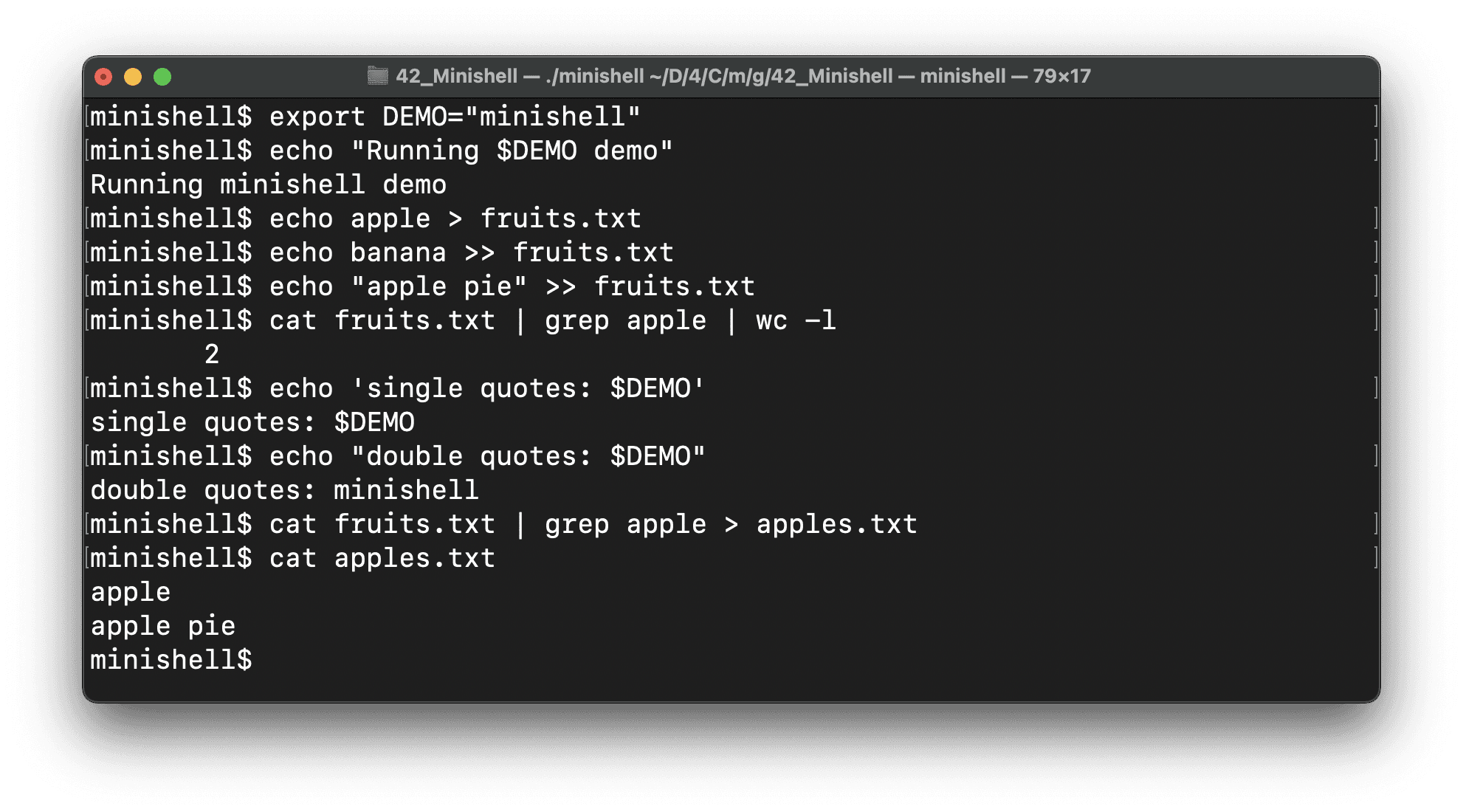
Support for command execution, pipes, and redirections
Built-in commands (
cd,echo,pwd,env,export,unset,exit)Environment variable expansion and quote handling
Proper signal handling and memory management
Clean, modular, and norm-compliant code
Impact
Working on Minishell significantly strengthened my understanding of Unix systems and low-level programming in C. It improved my ability to design robust software architectures, debug complex runtime issues, and reason about processes and file descriptors. This project also enhanced my problem-solving skills and prepared me for real-world systems programming tasks where reliability and precision are critical.
More work
2019 - 2025
A showcase of digital products I’ve crafted for SaaS, FinTech, and startup teams.